Friday, 14 April 2023

Singapore stops tightening amid faltering growth

MAS latest central bank to hold policy settings steady due to fading global economic growth and US and European bank ills


Singapore’s central bank defied expectations that it would tighten monetary policy for a sixth time since October 2021, announcing on Friday (April 14) that it would keep its policy settings unchanged despite stubborn price pressures at a 14-year-high and amid advance estimates that first-quarter economic growth fell well short of expectations.

The bellwether city-state had been among the first countries to tighten in response to rising inflation, though the latest move suggests the Monetary Authority of Singapore (MAS) has grown more concerned about the darkening global growth outlook in the wake of recent turbulence that has shaken American and European banking sectors.

“Concerns of a growth slowdown seem to be outweighing inflation, despite elevated core inflation in recent months,” said senior economists Chua Hak Bin and Lee Ju Ye of Maybank Investment Banking Group. In a research note reviewed by Asia Times, the pair wrote they had expected a “final re-centering of the [policy] band up to its prevailing level given sticky and elevated core inflation.”

The MAS uses exchange rates, managed against a trade-weighted undisclosed basket of currencies from Singapore’s major trading partners, instead of interest rates as its primary policy tool to manage imported inflation. Pre-announcement polling from Reuters and Bloomberg had put analysts expecting no change to monetary policy at all in the clear minority.

Read the full story at Asia Times.

Nile Bowie is a journalist and correspondent with the Asia Times covering current affairs in Singapore and Malaysia. He can be reached at nilebowie@gmail.com.

Thursday, 6 April 2023

Anwar’s nonalignment pays off big in Beijing

Malaysian leader wins $38 billion worth of investment vows from China all the while maintaining his New Cold War neutrality


Malaysian Prime Minister Anwar Ibrahim has cast his recent maiden state visit to China as a major foreign policy win, securing a record 170 billion ringgit (US$38.6 billion) worth of investment commitments from Beijing all the while asserting his country is non-aligned in the escalating New Cold War pitting Washington versus Beijing.

The billions of dollars of investment promises were spread across 19 memoranda of understanding (MOUs) covering various areas including green energy, electric vehicles and the digital economy, as well as an agreement to expedite long-delayed Belt and Road Initiative (BRI) infrastructure projects in Malaysia.

Anwar praised Chinese President Xi Jinping’s signature development initiative and called for its resumption in Malaysia following a three-year pandemic-caused lull. Previous Malaysian governments had suspended major China-funded projects such as the East Coast Rail Link and Trans-Sabah Gas Pipeline over corruption concerns, but they were eventually reinstated under renegotiated terms.

“Translating lofty ideals into practical reality, solidarity and cooperation is best exemplified in the realization of the Belt and Road Initiative,” Anwar waxed effusive in a speech at the Boao Forum for Asia held in China’s Hainan province on March 30. The forum is often referred to as the “Asian Davos” and is convened annually to promote regional economic integration.

Read the full story at Asia Times.

Nile Bowie is a journalist and correspondent with the Asia Times covering current affairs in Singapore and Malaysia. He can be reached at nilebowie@gmail.com.

Monday, 27 March 2023

Singapore’s Lee family feud takes a bitter turn

Sibling squabble over deceased father's residence pushes premier's brother into exile, which may or may not thwart his run for the presidency 


The 18th-century poet Percy Bysshe Shelley famously told of a ruined statue depicting a once powerful king, its fragments buried in desolate desert sands. The vivid poem “Ozymandias” is often interpreted as a warning against the hubris of building monuments to one’s own greatness, as even the mightiest empires wane and eventually crumble.

The message is one that resonated with Singapore’s founding prime minister Lee Kuan Yew, whose relatives say he cited Shelley’s sonnet as he pondered his legacy. Prior to his death in March 2015 at age 91, the revered elder statesman publicly expressed his wish that his family’s five-bedroom residence at 38 Oxley Road be demolished after his passing.

This was to avoid the cost of preserving the historic colonial-era bungalow and the risk that it would fall into disrepair, with the political patriarch having once remarked how he detested the way the homes of national figures such as India’s founding prime minister Jawaharlal Nehru were left in “shambles” when converted into memorial tourist attractions.

What exactly the late premier wanted and stipulated in his will is at the heart of an acrimonious nearly six-year dispute that has bitterly divided Singapore’s most prominent family, a family feud between siblings that has become part and parcel of the prosperous city-state’s increasingly partisan politics.

Read the full story at Asia Times.

Nile Bowie is a journalist and correspondent with the Asia Times covering current affairs in Singapore and Malaysia. He can be reached at nilebowie@gmail.com.

Friday, 10 March 2023

Corruption tables turn on Muhyiddin in Malaysia

Ex-premier arrested on corruption charges in a move that could blow back on Anwar’s ‘unity’ government at coming state polls


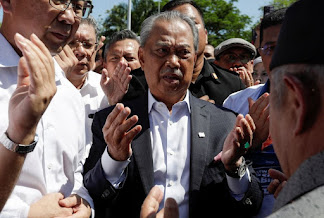
Former prime minister Muhyiddin Yassin is the latest Malaysian politician to face legal trouble and potential jail time after a court in Kuala Lumpur charged him with graft and embezzlement on March 10, a day after authorities arrested and questioned him over the alleged misuse of funds from a Covid-19 stimulus initiative.

The 76-year-old faces four counts of abuse of power involving 232.5 million ringgit (US$51.4 million) and two counts of money laundering of 195 million ringgit ($43.1 million), charges that are punishable by up to 20 years in prison and heavy fines. Muhyiddin has maintained his innocence and has described the charges as a political vendetta.

“This selective prosecution is a political ploy done with malicious intent,” the former premier told reporters after being charged, claiming the move intended to “suppress and destroy” the opposition Perikatan Nasional (PN) coalition he leads. “It is aimed at embarrassing me by dragging me to court… Therefore, no matter what explanation I provide, I will still be charged,” Muhyiddin said.

The Malaysian Anti-Corruption Commission (MACC) had been investigating allegations that beneficiaries of an economic relief program for ethnic Malay contractors had funneled kickbacks to Muhyiddin’s Parti Pribumi Bersatu Malaysia (Bersatu) political party, funds that are suspected to have been used for PN’s well-funded general election campaign in November.

Read the full story at Asia Times.

Nile Bowie is a journalist and correspondent with the Asia Times covering current affairs in Singapore and Malaysia. He can be reached at nilebowie@gmail.com.
Tuesday, 7 March 2023

Goldman Sachs and Anwar in 1MDB settlement showdown

Malaysian premier pressing US investment bank to honor agreement guaranteeing the return of $1.4 billion of seized assets worldwide


Prime Minister Anwar Ibrahim’s three-month-old administration won a key legal victory last week when Abu Dhabi’s International Petroleum Investment Co (IPIC) and its Aabar Investments PJS unit agreed to pay US$1.8 billion to settle a legal dispute linked to the sprawling 1Malaysia Development Berhad, or 1MDB, scandal.

The two sides had been locked in proceedings at the London High Court since 2018, when Malaysia challenged the validity of an arbitration award that had been negotiated between 1MDB and IPIC a year earlier during the premiership of Najib Razak, with the then-government arguing that the 2017 settlement was procured by fraud.

Anwar recently called the settlement a “huge success” for Malaysia and heaped praise on the country’s civil servants for their negotiating prowess, remarking that the amount reclaimed had exceeded his expectations. The premier now hopes to claw back even more money in a separate 1MDB-related dispute with Wall Street investment bank Goldman Sachs.

In January, Anwar called on Goldman to honor a settlement agreement reached in July 2020 under which the US bank, which helped to raise $6.5 billion from three bonds for 1MDB in 2012 and 2013 that would later be misappropriated, agreed to pay $2.5 billion while guaranteeing the return of $1.4 billion of 1MDB assets seized by authorities around the world.

Read the full story at Asia Times.

Nile Bowie is a journalist and correspondent with the Asia Times covering current affairs in Singapore and Malaysia. He can be reached at nilebowie@gmail.com.

Monday, 27 February 2023

Big spender Anwar buying political staying power

Malaysian leader’s record-breaking budget seeks to tax the rich, subsidize the poor and boost his popularity


Malaysian Prime Minister Anwar Ibrahim has unveiled the largest budget in his nation’s history replete with measures aimed at lowering the cost of living through subsidies and direct cash payments, even as his three-month-old administration claims to be trying to narrow the fiscal deficit.

The record 388.1 billion ringgit (US$87.5 billion) spending plan for 2023 was tabled in parliament by Anwar, who is also finance minister, on February 24 with a self-claimed emphasis on good governance and fiscal prudence. But with state polls due in July, the first electoral bellwether for the premier’s “unity government”, analysts and observers also see political dimensions to the budget.

With a projected slowdown in Malaysia’s export-driven economy, the supply bill’s ostensible focus is on shoring up economic resilience in the face of intensifying global headwinds. Economic growth is expected to moderate to 4.5% this year, down sharply from a stronger-than-expected 8.7% in 2022, the highest rate in two decades.

Whether or not Anwar, who came to power with support from former arch-rival the United Malaysia National Organization (UMNO) and others after November polls, can successfully navigate Malaysia’s economy through geopolitically precarious times will be key to his political staying power, say analysts, with the nation having gone through four premiers in as many years.

Read the full story at Asia Times.

Nile Bowie is a journalist and correspondent with the Asia Times covering current affairs in Singapore and Malaysia. He can be reached at nilebowie@gmail.com.

Wednesday, 15 February 2023

Singapore to tax and spend through global headwinds

Expansionary budget aims to soothe the sting of inflation and slowing growth but unpopular sales tax hike is still in the cards


Finance Minister Lawrence Wong expects “positive but slower” growth in Singapore this year due to high inflation and a slowing global economy, headwinds the city-state hopes to address through an expansionary budget designed to help households and businesses.

Unveiling a S$104 billion (US$78.4 billion) spending plan in parliament on February 14, Wong said Singaporeans will have to brace themselves for “a period of relatively higher inflation” that would remain elevated in the city-state at least for the first half of this year. Singapore’s headline inflation rate reached a more than decade-high of 6.1% in 2022, up significantly from 2.3% a year earlier.

Wong, who is also deputy premier and heir apparent to Prime Minister Lee Hsien Loong, stressed that while the economy has recovered to pre-pandemic levels, the country’s fiscal position remains tight, compelling the government to step up efforts to trim its budget deficit and raise revenue while pursuing a more targeted approach to aiding lower-income earners.

In what he previously described as his “Valentine’s Day present” to Singaporeans, Wong announced a slew of assistance measures including a S$3 billion ($2.26 billion) boost in subsidies to lower-income households to offset a higher goods-and-services tax (GST). He also announced higher taxes for multinational companies and on high-value properties and cars.

Read the full story at Asia Times.

Nile Bowie is a journalist and correspondent with the Asia Times covering current affairs in Singapore and Malaysia. He can be reached at nilebowie@gmail.com.

Friday, 10 February 2023

Anwar puts economy in focus amid fraught politics

Malaysian prime minister takes political heat for ‘nepotism’ and eyes economic overhaul as coalition partner UMNO culls dissenters


Malaysian Prime Minister Anwar Ibrahim finds himself in a difficult position, facing economic challenges against the backdrop of rising prices at home and increasing risks to the global economy coupled with domestic political challenges that risk widening disenchantment from his own support base.

Anwar’s fledgling coalition government could only look on as its former nemesis-turned-key partner, the United Malays National Organization (UMNO), recently expelled and suspended a number of prominent politicians for disciplinary breaches, including former ministers who had long been opposed to party chief and deputy prime minister Ahmad Zahid Hamidi’s leadership.

The purge wiped out nearly all of Zahid’s detractors and eliminated the threat of them taking any top posts ahead of an upcoming party election set for March 18. It followed a motion passed at the party’s general assembly last month blocking an electoral contest for UMNO’s top two posts, enabling Zahid to tighten his stranglehold over the once-dominant party.

Anwar named Zahid as his deputy, despite his being on trial for corruption and abuse of power, after UMNO lent its support to his multiracial Pakatan Harapan (PH) coalition, giving it a parliamentary majority after November 19 elections resulted in a hung parliament. Many of Anwar’s supporters saw the move as the price to pay for political expediency and stability.

Read the full story at Asia Times.

Nile Bowie is a journalist and correspondent with the Asia Times covering current affairs in Singapore and Malaysia. He can be reached at nilebowie@gmail.com.

Monday, 30 January 2023

The Straits Times caught in a readership lie

Singapore’s state-funded paper of record under fire for hyper-inflating circulation figures with more damning revelations likely to come


SPH Media Trust, the publicly-financed publisher of The Straits Times, Singapore’s newspaper of record, and other daily broadsheets, is under parliamentary scrutiny after an internal review found the circulation numbers of its titles to be arbitrarily inflated by up to 95,000 copies, or about 10% to 12% of average daily circulation.

The Straits Times disclosed on January 9 several practices used to inflate circulation, including instances where copies of SPH Media titles were printed, counted for circulation and then destroyed. Lapsed contracts had continued to be counted in circulation data and a project account had even been injected with additional funding “to purchase fictitious circulation.”

The internal review covered circulation figures for the period spanning September 2020 to March 2022. Still, SPH Media has not said for how long such practices took place, nor has it named any of the staff involved, noting only that four employees had left the company over the incident in December while three staff had been served warning letters.

Not only have the revelations opened the publisher to legal action by advertisers and shareholders, but its taxpayer funding has been cast into uncertainty as well, with the Ministry of Communications and Information (MCI) undertaking a review of its decision to finance SPH Media to the tune of S$900 million (US$685 million) over a five-year period.

Read the full story at Asia Times.

Nile Bowie is a journalist and correspondent with the Asia Times covering current affairs in Singapore and Malaysia. He can be reached at nilebowie@gmail.com.

Wednesday, 18 January 2023

UMNO already giving Anwar political headaches

Malaysian leader’s pact with erstwhile rival party is quickly taking the shine off his reform credentials


Anwar Ibrahim’s long-time supporters always believed his rise to the premiership would mark a new era of clean governance and democratization in Malaysia. But few anticipated that when the 75-year-old politician finally clinched the top job, his government would include the very United Malays National Organization (UMNO) party he spent the bulk of his career lambasting as corrupt and anti-democratic.

UMNO was arguably true to that critique at its recently concluded general assembly meeting, where the party’s top two leadership posts were closed to a vote and its incumbent president castigated the judiciary for supposedly politically persecuting imprisoned ex-premier and UMNO stalwart Najib Razak.

While Anwar may have benefited from UMNO leader Ahmad Zahid Hamidi, his graft-accused deputy premier, maintaining his leadership position uncontested by a potential challenger opposed to cooperation with his governing Pakatan Harapan (PH) bloc, concerns are rife that the two politicians’ Faustian bargain will eventually end in political betrayal.

Meanwhile, in the Borneo state of Sabah, Anwar’s “unity government” faced an early stress test when a Zahid-aligned UMNO leader tried and failed to topple the state’s pro-Anwar administration through political defections. While the attempted political putsch was foiled, analysts say the drama is still evolving and could have implications at the national level.

Read the full story at Asia Times.

Nile Bowie is a journalist and correspondent with the Asia Times covering current affairs in Singapore and Malaysia. He can be reached at nilebowie@gmail.com.